for journalists and researchers · press kit
Cite the British Resilience Index
The British Resilience Index is free to cite. It is non-partisan, built entirely from official open data, and every figure is sourced and reconciled to its primary publisher. This page explains how to reference the project, where to find shareable cards for each analysis, and how to reach us with a correction.
October 2026 release. The score runs from 0 to 100 where higher means more stress.
How to cite
Reference us in an article, report or paper
You are welcome to quote and reproduce our analysis with attribution. A simple credit to the British Resilience Index with a link is enough. If you are working with the figures themselves, every release is downloadable as CSV and JSON with a full data dictionary on the data page. Suggested forms:
The project as a whole
British Resilience Index. britishresilienceindex.com. Accessed [date].
A specific analysis
British Resilience Index, “Fuel poverty in England,”
britishresilienceindex.com/deep-dive/fuel-poverty. Accessed [date].
A single figure
Credit the British Resilience Index as the analyst and the original publisher as the data source, for example “British Resilience Index analysis of DESNZ sub regional fuel poverty data”. Where you quote a source figure directly, the underlying statistics are Crown copyright and available under the Open Government Licence, so please credit the original publisher too. Every publisher is listed on our data sources page.
For journalists
What the project is, in one place
Non-partisan by design. The index does not assign blame to political parties. It tracks whether the core systems of national life are improving, deteriorating or entering dangerous levels of strain.
Source first. Every figure traces to a primary official source and is reconciled to that publisher’s own headline before it is displayed. Nothing is estimated to fill a gap.
Methodology led. The national score is a transparent composite across 11 domains, with published weights, normalisation and a Monte Carlo sensitivity analysis. The method is open.
Open data throughout. The index and its 78 deep-dives are built entirely from official open data (ONS, DWP, DfE, NHS, MoJ, DfT, MHCLG, the Environment Agency and others).
Shareable assets
A social card for every page
Every deep-dive has its own branded 1200 by 630 card, ready to drop into a post or a slide. The pattern is /share/dd/<slug>.png, so the fuel poverty card lives at /share/dd/fuel-poverty.png. The master project card is at /share/og.png.
Master card
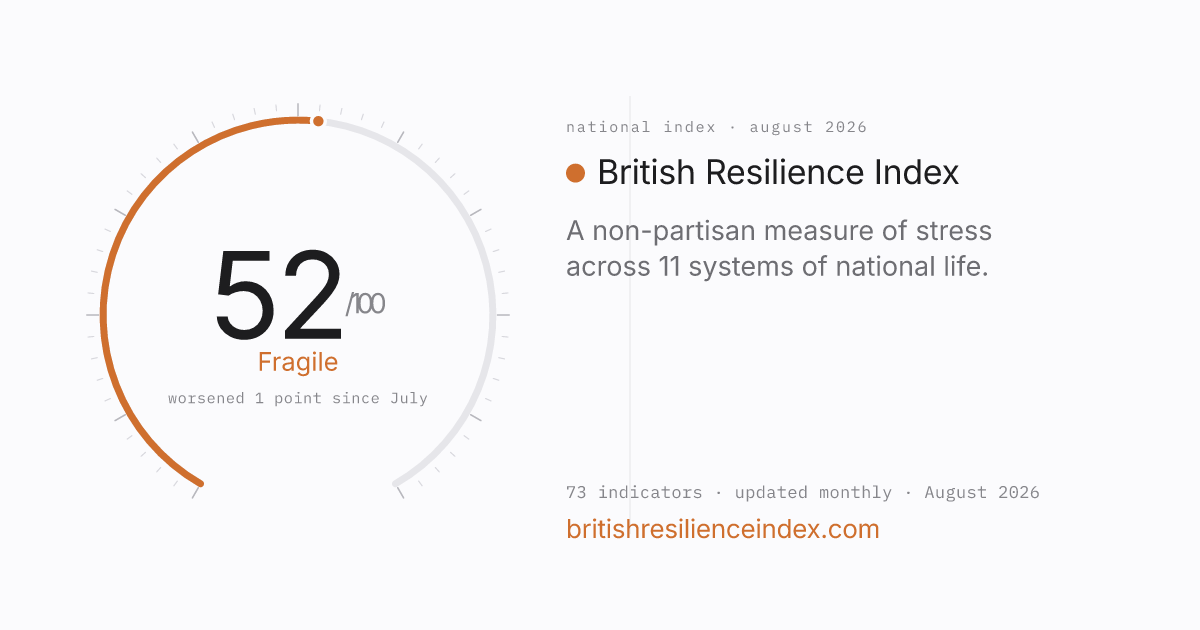
Cards are free to use when reporting on or linking to the British Resilience Index.
For AI and researchers
Machine readable by default
A plain text summary of the whole project, with a one line description of every deep-dive, is published for language models and answer engines at /llms.txt. Structured data is attached throughout: every deep dive carries Article, breadcrumb, Dataset and FAQ schema, every domain page carries breadcrumb schema, and Organization and WebSite schema run sitewide. A full sitemap, so the figures here can be found and attributed accurately.
Corrections and enquiries
Found a figure that looks wrong?
Data integrity comes first here. If a number looks off, we would rather know. We reconcile every figure to its primary source, and where a source updates we recompute rather than trust the older reading. If you spot something that does not match the official publisher, or you have a question about how a figure was derived, please get in touch and we will check it against the primary data.
Corrections and press enquiries: Copyor open in your mail app. Corrections are treated as a priority and, where a figure changes, the change is noted on the page it affects.
The method behind any figure is set out on the methodology and data sources pages.